You See an Invisible Man. I See the French Letter H.

This is about us, you and me. Because art is never just about art.
You See an Invisible Man. I See the French Letter H.
A black figure against a dark background. The contours are barely distinguishable. My eyes need time to adjust. Then I begin to make out a face where, a moment ago, I saw only darkness. The figure was there the whole time. At the Kerry James Marshall exhibition at the Musée d’Art Moderne de Paris, I was drawn to the section entitled Invisible Man. In 1980, Marshall painted A Portrait of the Artist as a Shadow of His Former Self, inspired by Ralph Ellison’s 1952 novel Invisible Man. Ellison’s narrator is a Black man whom a racist society refuses to see on his own terms.
Marshall makes that refusal a question for the viewer. At first glance, the black of the figure and the darkness around it seem almost continuous. As I keep looking, differences emerge. The black has depth and variation. I begin to wonder how often I’ve taken the limits of my own attention for the limits of what’s there. I think of Charles White, whose drawings gave Black subjects a monumental presence. I think of Faith Ringgold, who used textiles to tell stories that had been left out of American history. As an artist who also works with drawing and textiles, I keep coming back to a question their work raises for me. Who gets to appear as a person with a life of their own? Who is asked to stand for an entire community?
Further along in the exhibition, I stopped in front of Kerry James Marshall’s Black Painting (2003) at the Musée d’Art Moderne de Paris. At first, I could barely make out a room. As my eyes adjusted, I began to see a pair of shoes on the floor, a Black Panther flag and, finally, two people lying in bed.
The museum label suggested that the scene might evoke the moments before Chicago police killed Fred Hampton in 1969, as he lay in bed beside his pregnant partner, Akua Njeri. Then it drew my attention to a book in the room, Angela Davis’s If They Come in the Morning, published two years later. I looked back at the couple. The longer I stood there, the more I could see, and the less certain I was that I knew whose room I was looking into. In the quiet of the gallery, I thought of something I could still hear as clearly as if I were home in Uzbekistan. It was the sound of my family calling me by my name.
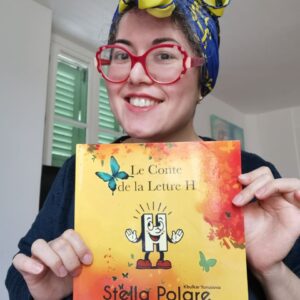
My name is Khulkar. In the house where I grew up in Uzbekistan, I could recognize the sound of it from the next room. In France, the first sound almost always changes when someone reads my name aloud. The H is silent in French, and the sound I know in the Kh of my name rarely makes it off the page. I’ve lived here for eighteen years. In all that time, I’ve hardly ever heard anyone here say my name the way my family did. Perhaps that’s part of why I’ve spent years drawing the letter H in my own way. In my drawings, the H takes the shape of a hand gesture I use to suggest the Minotaur’s horns. On the page, I can give him all the space I want.
I think of a choice familiar to many people who move abroad. Someone offers you work you would never have considered back home. You say yes. There’s rent to pay, you want to stay, and you still believe you can make a life here. Someone who grew up here and has family to fall back on may be able to wait for a better offer. Later, when someone asks what you do, you tell them about the job you took. That may be all they ever know about you. They may never learn what you did before you arrived or what you’re working towards. You remain yourself, yet the way others interpret your presence changes.
Since becoming a mother, I’ve begun to notice what gets counted at home. When I take my son to his childminder, my husband pays her for the hours she spends caring for him. When I spend those same hours caring for our son, there’s no invoice. In a family where the father is the main earner, his contribution appears in the bank account. The hours a mother spends caring for her child, and the work of her own she sometimes puts aside, are harder to see. When my son reaches for me, I want him to know I see him. I also want the work of being there for him to be seen. I wonder how old he’ll be when he first feels that attention is something he has to earn.
When I looked back at Marshall’s self-portrait, I could make out his face almost immediately. I thought about how much it would mean to hear someone in France say Khulkar the way my family says it. Then I thought about what I’d want them to do next. Perhaps just wait a moment and let me tell them something about myself.
Nothing had changed in the painting, Something had changed in me.
How many people have you considered invisible simply because you never learned to see them?
— Khulkar Yunusova (Stella Polare)
You See / I See
Musée d’Art Moderne de Paris, November 2026