“Plein Soleil” Exhibition. You see flip-flops. I see a curse.

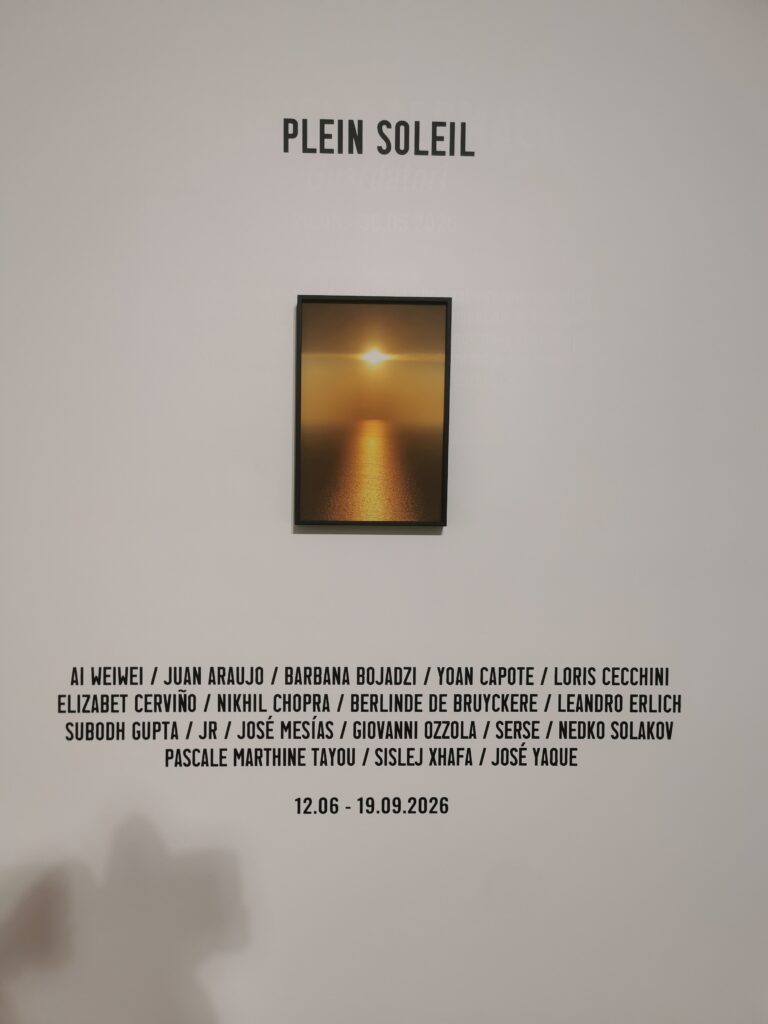
“Plein Soleil” Galleria Continua appears at first to be an exhibition about summer, sunlight and Mediterranean beauty. Yet beneath this brightness lies a reflection on climate anxiety, migration, pollution and violence.
Summer rarely arouses suspicion. We put on light clothes, buy tickets, take our flip-flops out of the wardrobe and head to the sea, as though there were a season in which history finally ceased to exist. Summer has long stopped being merely a season. It has become one of the most convincing cultural fantasies of our time—a period when politics gives way to travel, anxiety dissolves in sunlight, and the world appears simpler than it really is.
That is why the first thing I thought about when leaving the exhibition Plein Soleil at GALLERIA CONTINUA was not the paintings. Not the sculptures. Not even the sun. I was thinking about beach flip-flops, the most inconspicuous object in a summer wardrobe.
You see flip-flops. I see a curse.
The title of the exhibition immediately directs the gaze. Plein Soleil—“Full Sun.” It promises the Mediterranean, holidays, white walls, salty air and a blinding midday. Yet the curators deliberately refer not so much to the sun itself as to René Clément’s 1960 film of the same name, in which a murder takes place not at night, as classical film noir would require, but under the brightest daylight.
This fundamentally changes the meaning of light. We are accustomed to believing that light exposes. That it makes things visible. But Clément shows the opposite. Sometimes brightness itself helps to conceal a crime. Beauty becomes so convincing that the eye stops searching for what lies behind it. This is the idea inherited by the exhibition. It does not oppose beauty and violence. It reveals how easily the former becomes a shell for the latter.
For me, this idea resonated unexpectedly because I grew up in Uzbekistan. Whenever the European imagination pictures sunlight over the seashore, I always feel a slight distance. Uzbekistan has no sea. Moreover, our neighbouring countries have no sea either. In our region, the sea was never part of everyday life. It existed more as a geographical dream than as a place of leisure.
The sun, however, was always there. But it is nothing like the sun of tourist postcards. It is harsh. Biting. Scorching. In summer, people do not seek sunlight; they seek shade. Midday becomes the hour of empty streets. The sun does not promise freedom. It reminds people of the limits of their own bodies.
Today, this feeling has become even more personal for me. I am the mother of a young child with asthma. Every summer is now connected not only with joy, but also with constant calculations: how hot is it today, what is the level of air pollution, can we go for a walk now, or would it be better to wait until evening? The sun has stopped being a beautiful background. It has become a circumstance that must be taken into account.
Perhaps that is why I did not read Plein Soleil as a promise of happiness, but as a warning. Full sun is the moment when there is nowhere left to hide.
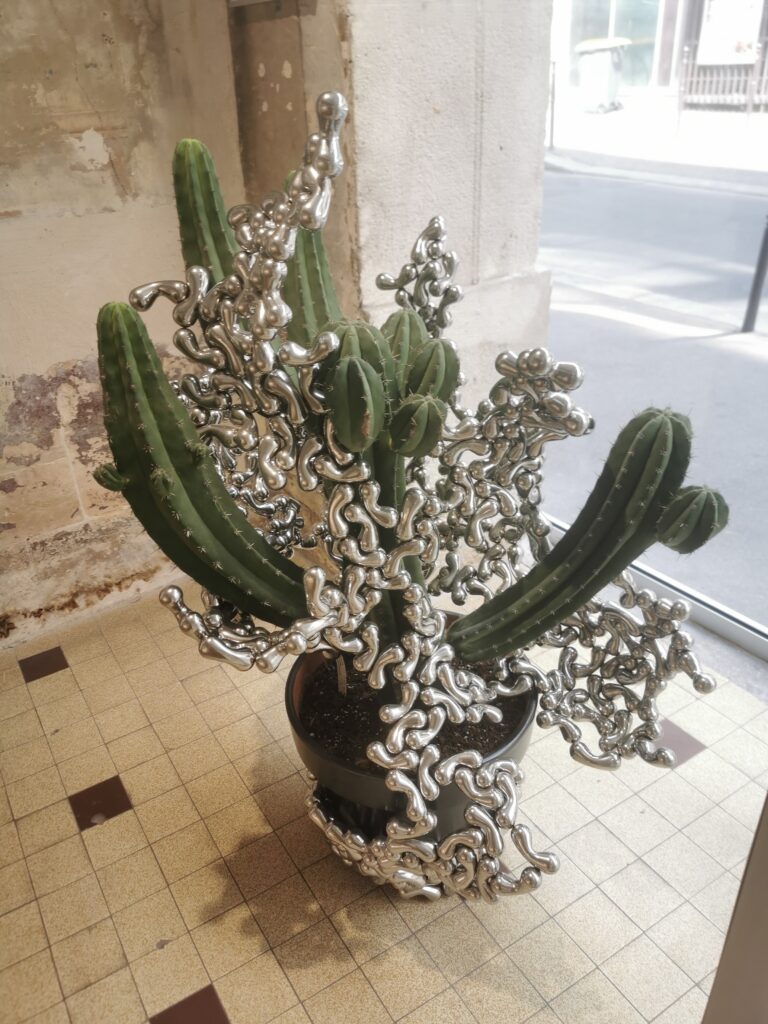
The exhibition begins with precisely this feeling. At the entrance to the gallery stands a cactus—Loris Cecchini’s work Penumbrae (Polaskia chichipe), 2026. It is a living Mexican cactus joined with welded stainless-steel modules. The cactus, usually protected by its spines and appearing resilient, suddenly looks fragile within this dialogue of materials. The cold, heavy stainless-steel modules seem to grow through the living plant, simultaneously supporting and threatening it.
Gradually, it becomes clear that fragility is one of the exhibition’s central themes. It is unexpectedly continued in Pascal Marthine Tayou’s Plastic Tree. A fruit tree grows out of the wall. From a distance, it appears to belong to an almost idyllic summer garden. But when you come closer, its fruit turns out to be plastic bags. The tree continues to bear fruit, but its harvest can no longer be eaten.
Tayou does not depict environmental catastrophe directly. He works much more subtly. One of the oldest symbols in human culture—the tree as an image of life, fertility and the continuity of generations—quietly begins to produce the defining product of contemporary civilisation: plastic.
The most frightening thing here is not the plastic. The most frightening thing is the absence of surprise. The bags no longer look like foreign elements. They have become part of the tree. Pollution is no longer perceived as an exception and begins to appear as the natural state of the world.
The curse is born precisely here. Not in the plastic, but in the human ability to adapt. We are surprised only by what happens for the first time. Anything repeated for long enough begins to be perceived as normal. Even a tree bearing rubbish as fruit.
Today, this work reads almost like a document. As I write these lines, forest fires are once again becoming part of the European summer. Forests are burning in France. Spain is burning. Maps showing the spread of fires appear in the news almost as regularly as weather forecasts. Summer, which until recently was associated with holidays, increasingly arrives together with smoke, evacuations and a sense of climatic instability.
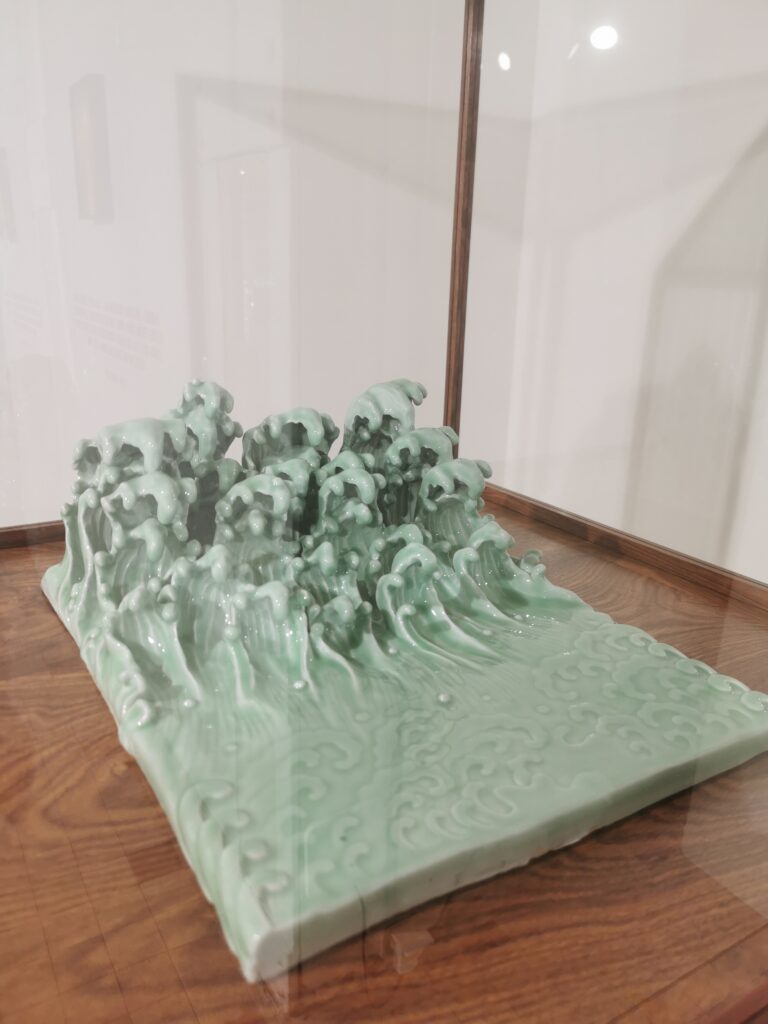
The artist does not predict the future. He shows the present. And if Plastic Tree speaks about a land that humanity has imperceptibly rewritten in its own image, Ai Weiwei’s Wave carries this conversation towards the sea.
From a distance, the work resembles an almost classical seascape. But the longer you look, the more clearly you notice that the crest of the wave is no longer foam. It turns into claws. The sea no longer invites humanity. It seems to answer back.
After Wave, it becomes impossible to look at flip-flops in the same way. They promise an easy path towards the sea. But the sea shown by Ai Weiwei is no longer a place of leisure. It carries the memory of migration, human deaths, climate disasters and vulnerability.
In this exhibition, water ceases to signify a holiday. It becomes a force that simultaneously calls and threatens. And then you understand that the curse is not hidden in the sea. Nor in the sun. It is hidden in our capacity to forget.
We see the beach before we notice the history of the place. We see azure water before remembering those for whom it became the final border. We see a holiday before asking who is even allowed the freedom to travel.
It is here that flip-flops cease to be footwear. They become a symbol of privilege. Some people put them on in order to walk slowly into a warm sea. Others enter that same sea barefoot, knowing they may never reach the shore again.
If the first part of the exhibition gradually destroys familiar images of nature, the second compels us to think about what is happening to the human gaze itself. It is not only the world that is changing. We are changing too.
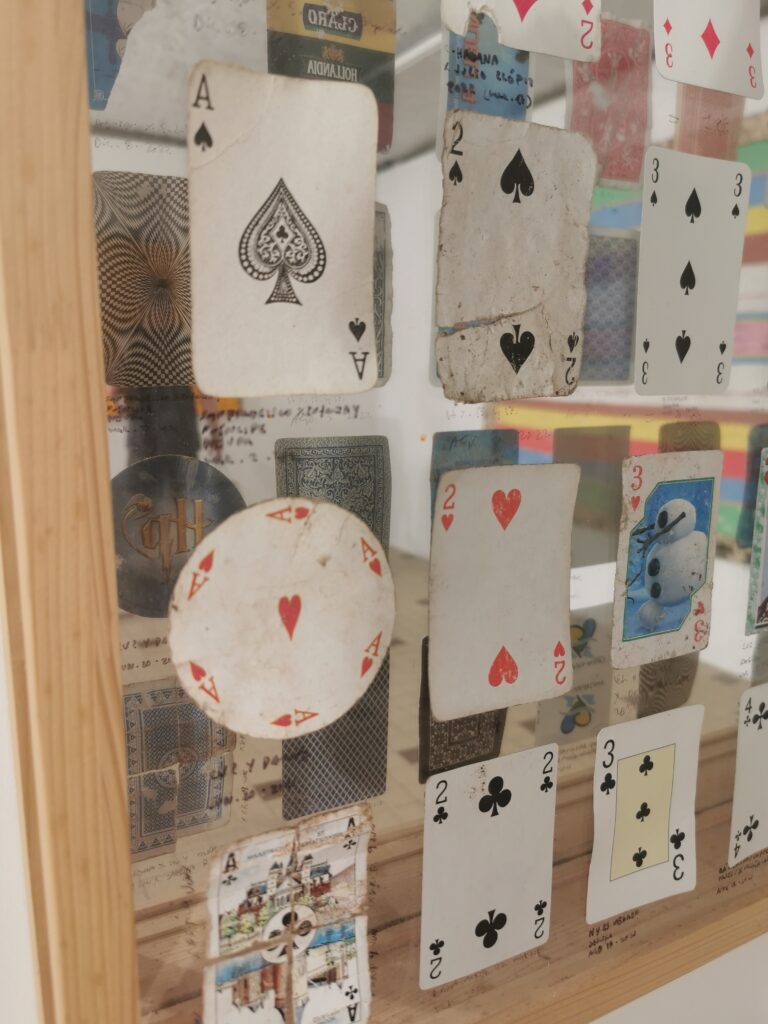
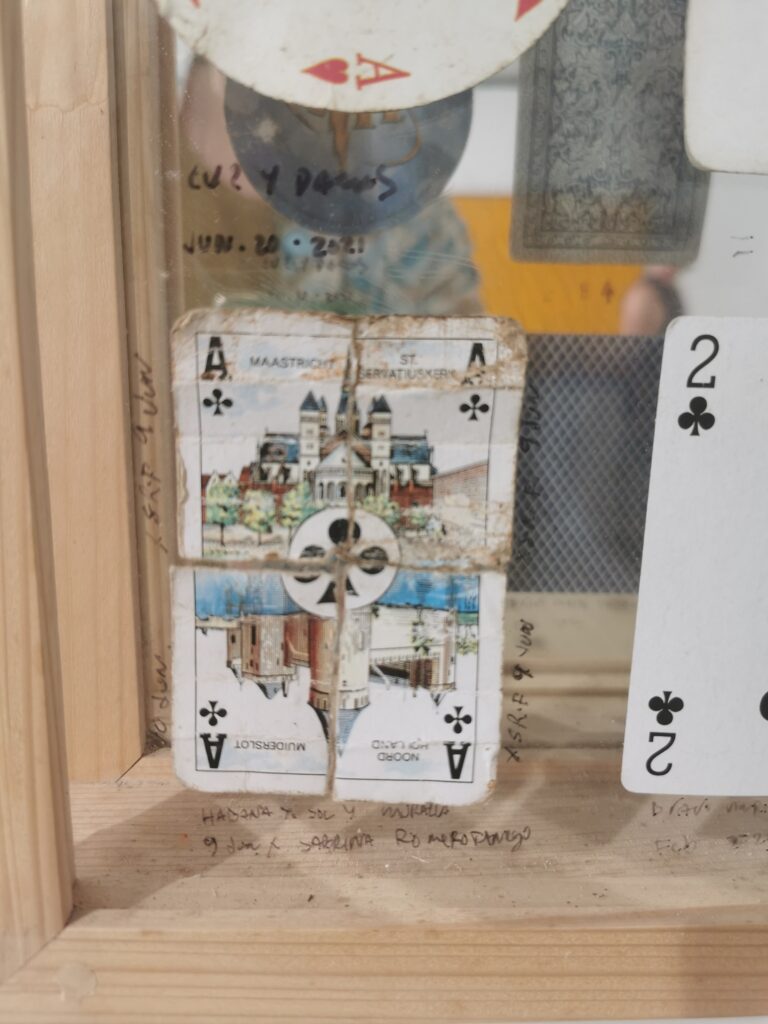
This is José Mesías’s work Naipes (2), 2014–2022, made from playing cards, wood, glass and a mirror. Worn, faded and partially overlapping, the cards appear not as elements of a game, but as fragments of other people’s biographies, preserving traces of touch and time.
Their familiar system of numbers and suits falls apart, and it becomes impossible to understand what game is being played or who is winning. The mirror incorporates the surrounding space and the viewer’s own reflection into the work, transforming us from observers into participants in this uncertain game.
The fragile cards are enclosed within a solid museum structure: they are preserved, but at the same time deprived of the possibility of passing from hand to hand again. The work therefore speaks not so much about a game as about memory, chance and fate.
It is precisely this almost invisible anxiety that makes the work so powerful. It does not force the viewer to experience shock. It makes the viewer pause.
Perhaps this is what unites most of the works in Plein Soleil. None of them seeks to stage a spectacular catastrophe. The artists do not compete in images of destruction. They examine a different condition—the moment when catastrophe becomes so familiar that it no longer looks like catastrophe.
We continue living. We continue travelling. We continue photographing sunsets. We continue buying tickets to the sea. And at the same time, we accept as part of everyday life the news of fires, floods, disappearing species and new migration crises.
Catastrophe ceases to be an exception. It becomes a background. Perhaps this is the true curse of the contemporary world. Not tragedy itself, but the ability to live beside it for so long that it gradually dissolves into habit.
It then becomes clear that the exhibition is not only about ecology. Nor only about politics. It is about memory. About the way contemporary culture is gradually losing its ability to distinguish between the natural and the artificial, the temporary and the permanent, the surface and the depths.
In this sense, Plein Soleil becomes an exhibition not so much about the world as about the way we look at it.
Roland Barthes once wrote that myth transforms history into nature. What has been created by human beings begins to be perceived as something natural and inevitable. We stop asking questions. We stop noticing where things come from.
Summer has perhaps become one of the most successful myths of our time. We associate it with freedom, holidays, travel, long evenings and the sea. But this image is so convincing that almost everything else disappears behind it: climate anxiety, mass tourism, the exhaustion of landscapes, fires, migration and inequality.
Beauty is not the opposite of violence. It becomes its perfect mask.
That is why, when leaving the gallery, I continued to think about flip-flops. Not because they are present in the exhibition. They are not. But for me, they became the most precise image of what these artists are addressing.
Flip-flops promise lightness. They promise a holiday. They promise a few carefree steps towards the water. But after Plein Soleil, this path can no longer be perceived as innocent.
Behind each of those steps, other stories begin to emerge. The stories of those who crossed the same sea not for leisure. The stories of shores that every summer increasingly meet not only tourists, but also smoke from forest fires. The stories of a natural world that can no longer separate itself from the traces of human activity.
And then you realise that the curse lies neither in the sun nor in the sea. It lies in humanity’s astonishing ability to transform even the most alarming changes into a familiar landscape.
We get used to everything. To plastic fruit. To burning forests. To waves resembling claws. To news that ten years ago would have seemed impossible.
This is why the exhibition leaves such a powerful impression. It does not accuse. It does not moralise. It does not offer simple answers. It does something far more difficult.
It restores the viewer’s capacity to be surprised again. To see again. To question again what appears obvious.
When I stepped outside, Paris was flooded with bright July sunlight. People were sitting on café terraces. Someone was hurrying towards the Métro. Someone was pulling a suitcase. Someone was walking in flip-flops.
And suddenly I realised that I could no longer look at them in the same way as before. Because sometimes the most ordinary object becomes the most precise portrait of an era.
You see flip-flops.
I see a curse.
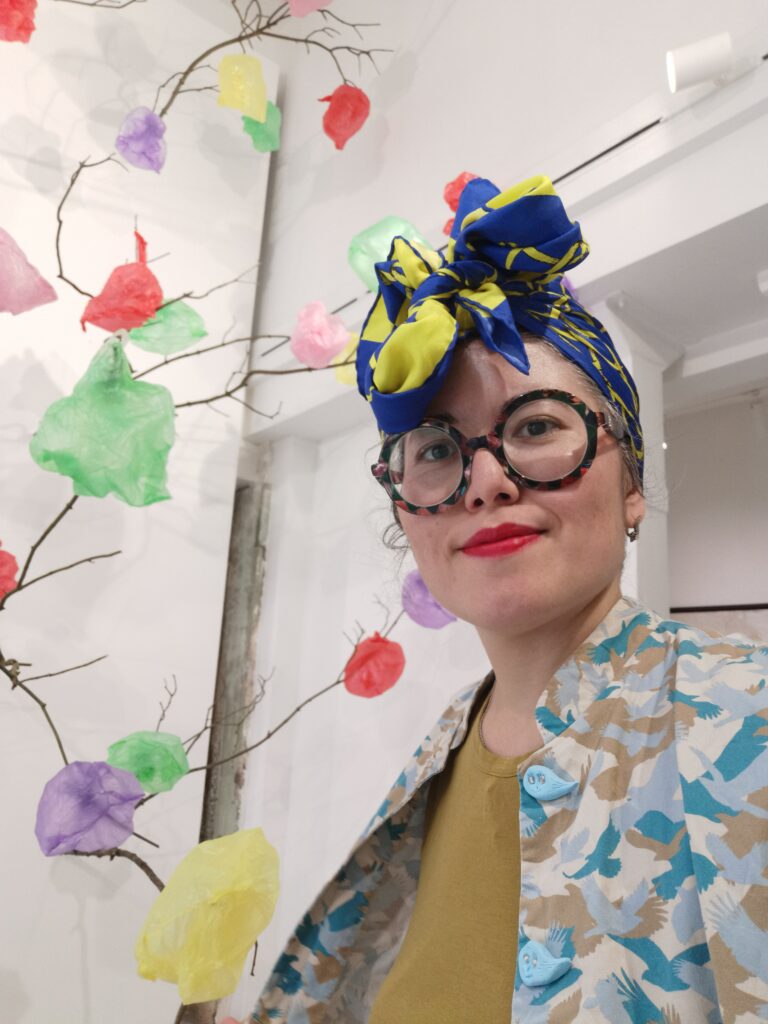
Khulkar Yunusova (Stella Polare) is a Uzbek contemporary artist, based in Paris, whose interdisciplinary practice explores memory, childhood, and cultural transmission. Through the series You See / I See, she shares personal reflections on exhibitions, approaching them from the perspective of an artist rather than an art critic.